Why Your 8-Year-Old Keeps Half-Finishing Chores (and the Jobs She Can Actually Own)
By Keosha · The Parent Hub, Chore Report · · 8 min read

It's Saturday morning and you asked your 8-year-old to clean the bathroom. Forty minutes later she announces she's done. There's a damp towel in the tub, toothpaste on the mirror in a new and creative pattern, and the toilet has been — and this is generous — looked at.
So you sigh, grab the spray bottle, and redo it yourself. Again. Same as last week. And you're starting to wonder whether she's lazy, whether you're too picky, or whether chores are just a thing other families manage to do.
The short answer: age appropriate chores for kids depend less on the birthday than on the size of the job and how clearly "done" is defined. Most 7-to-9-year-olds can handle short, one-step jobs with a checklist. Most 10-to-12-year-olds can own a whole room or a recurring task. Most 13-to-16-year-olds can run multi-step jobs like a full load of laundry or a weeknight dinner. Match the job to the kid in front of you, teach it once, then stop redoing it.
Why does my kid keep half-finishing chores?
Here's the uncomfortable, slightly freeing truth: "clean the bathroom" isn't one job. It's about nine jobs wearing a trench coat. Wipe the sink. Wipe the mirror. Scrub the toilet. Hang the towels. Empty the trash. An adult sees the whole list automatically. An 8-year-old sees a room and a vague sense that you want it to be different.
Three things usually go wrong.
- The job is the wrong size.
Not too hard, exactly — too big. Most young kids can do every individual step of cleaning a bathroom. What they can't do yet is hold the whole sequence in their head and know when they've reached the end.
- "Done" lives only in your head.
You know what a clean bathroom looks like. She knows what she did. Those are two different pictures, and the gap between them is where the argument happens.
- The job was picked by birthday or by sibling.
"Your brother did dishes at eight" is one of the most expensive sentences in a house. Kids are different. Some 8-year-olds are meticulous and slow; some are fast and messy. Matching the chore to the kid — not the calendar, not the older sibling — prevents half the fights before they start.
And when you redo the job? You aren't being picky. You're just accidentally teaching that the job ends when you take over.
What chores can kids actually handle at each age?
Treat these as starting points, not report-card standards. If your kid is ready for more, give her more. If she's not there yet, shrink the job. Our free Chores by Age printable has a longer list you can stick on the fridge and circle.
Ages 7 to 9: short jobs, one clear finish line
Think jobs that take ten to fifteen minutes and have an obvious end.
- Make their bed (flat-ish counts)
- Feed the pet and refill the water
- Set and clear the table
- Put away their own clean laundry
- Empty small trash cans into the big one
- Wipe the bathroom sink and counter (just that — not "the bathroom")
- Match socks, sort recycling, water plants
The key at this age is the checklist. If the job has more than one step, write the steps down. Pictures work for the younger end.
Ages 10 to 12: owning a room or a routine
Now kids can start to hold a sequence and work without you nearby.
- Clean the full bathroom, with a checklist taped inside the cabinet
- Load and unload the dishwasher
- Vacuum a room, including under things
- Take the trash and recycling to the curb on pickup day
- Pack their own school lunch
- Run a load of laundry with help on the settings
- Help make one part of dinner
This is the age for ownership. Not "help with the dishwasher" but "the dishwasher is yours on weeknights."
Ages 13 to 16: multi-step jobs with real judgment
Teens can handle jobs where things go sideways and they have to figure it out.
- Do their own laundry start to finish
- Cook a simple weeknight dinner
- Mow the lawn or handle a yard job
- Clean the kitchen after dinner, counters and stovetop included
- Deep-clean a bathroom
- Grocery-shop from a list
- Watch a younger sibling for an hour
Teens also tend to do better with fewer, bigger jobs than a pile of tiny ones. One real job they own beats six little ones they'll negotiate.
How do you hand a chore over so it stays done?
The handoff is where most chores live or die. A job that's been taught properly mostly stays done. A job that was just announced usually doesn't.
- Shrink it first.
If the job keeps coming back half-done, cut it in half. "Bathroom" becomes "sink and mirror." Once that's solid, add the toilet.
- Define "done" out loud and on paper.
Write three to five specific steps. "Mirror has no spots when you look from the doorway" beats "clean the mirror." Tape the list where the job happens.
- Do it together, then watch, then let go.
First time, you do it while she helps. Second time, she does it while you're in the room. Third time, she does it alone and you check. That's it — three rounds, not three months.
- Check against the list, not your standards.
When you inspect, use the list. If every step is done, the job is done — even if you'd have folded the towel differently.
- Hand it back instead of redoing it.
This is the hard one. If a step is missed, she fixes it. You don't. The moment you grab the spray bottle, the job becomes yours again.
- Let the system do the reminding.
Once the job is taught, it goes on a chart with a day attached, so you're not the one asking. We dig into this in how to get kids to do chores without reminding.
What to say when the job comes back half-done
The moment is usually the doorway, the job looks rough, and you can feel the redo coming. Keep it short and say it once.
"Let's look at the list together. Which steps are done?"
Then, when she finds the missed one: "Great — finish that one and it's done."
And if you realize the job was too big: "That one was too much for one go. This week, you've got the sink and the mirror. We'll add the rest later." That isn't lowering the bar. It's putting the bar where she can reach it, then raising it on purpose.
If you're worried about fairness between siblings when jobs differ by age, dividing chores fairly between siblings walks through how to make fair a property of the system instead of your daily ruling.
Set it up this week
- Pick one job per kid that's currently causing a redo. Just one.
- Shrink it to a size they can finish in fifteen minutes (younger) or thirty (older), and write a three-to-five-step "done" list.
- Teach it this weekend: you do it, they help; they do it, you watch; they do it, you check.
- Put it on a weekly chore chart with a set day, so the chart asks instead of you.
- If you pay for chores, price it now so nobody has to negotiate later — the Chore Bux rate guide and how much allowance by age help you land on numbers that make sense for your family.
All of this works on paper with the free printables, and paper is a great warm-up. If you'd rather not run the chart by hand, Chore Report runs the same system automatically: you assign the chores and set the rates, kids check off their jobs and submit their work, and you approve it with a tap. Rotations keep shared jobs fair and streaks track themselves. It's free to start on iPhone, Android and the web — Download now at chorereport.com.
Frequently Asked Questions
What chores should an 8-year-old be able to do?
Most 8-year-olds can handle short, single-step jobs with a clear finish: making their bed, feeding a pet, setting and clearing the table, putting away their laundry, emptying small trash cans, and wiping a bathroom sink. Bigger jobs like "clean the bathroom" are usually too many steps at once. Break them into pieces, write a short checklist, and add steps as each piece becomes reliable. Your own kid's speed and focus matter more than any list.
How do I stop redoing my kid's chores?
Define "done" with a short written list, check the job against that list, and hand back any missed step for your kid to finish. If you keep redoing a job, it's probably too big — shrink it until they can complete it. Redoing it yourself teaches that the job ends when you step in. Handing it back, calmly and once, teaches that the job ends when it's actually finished.
Should siblings of different ages have the same chores?
Not necessarily. Fair doesn't mean identical; it means each kid has a job that fits them and a clear system for how jobs are assigned and paid. A 13-year-old cooking dinner and an 8-year-old setting the table can both be fair. Rotating shared jobs where it makes sense and posting the chart where everyone can see it keeps the "why does she get the easy one" debate from landing on you.
What chores can a teenager do?
Most teens 13 to 16 can handle multi-step jobs that require judgment: doing their own laundry start to finish, cooking a simple dinner, cleaning the kitchen after a meal, mowing the lawn, grocery shopping from a list, or watching a younger sibling briefly. Teens often do better with one or two bigger jobs they fully own than many small tasks. Give them the outcome you want and let them figure out the order.
How long should a chore take for a kid?
A useful starting point is about ten to fifteen minutes per job for kids 7 to 9, up to around thirty for 10 to 12, and longer for teens handling something like dinner or yard work. These aren't rules — they're a way to spot a job that's too big. If a chore regularly drags far past that or ends half-done, split it in two and build it back up once the first half sticks.
Run this on paper tonight
Everything in this article works on paper. Print these, stick them on the fridge, and the app can come later. See everything in Door 1.
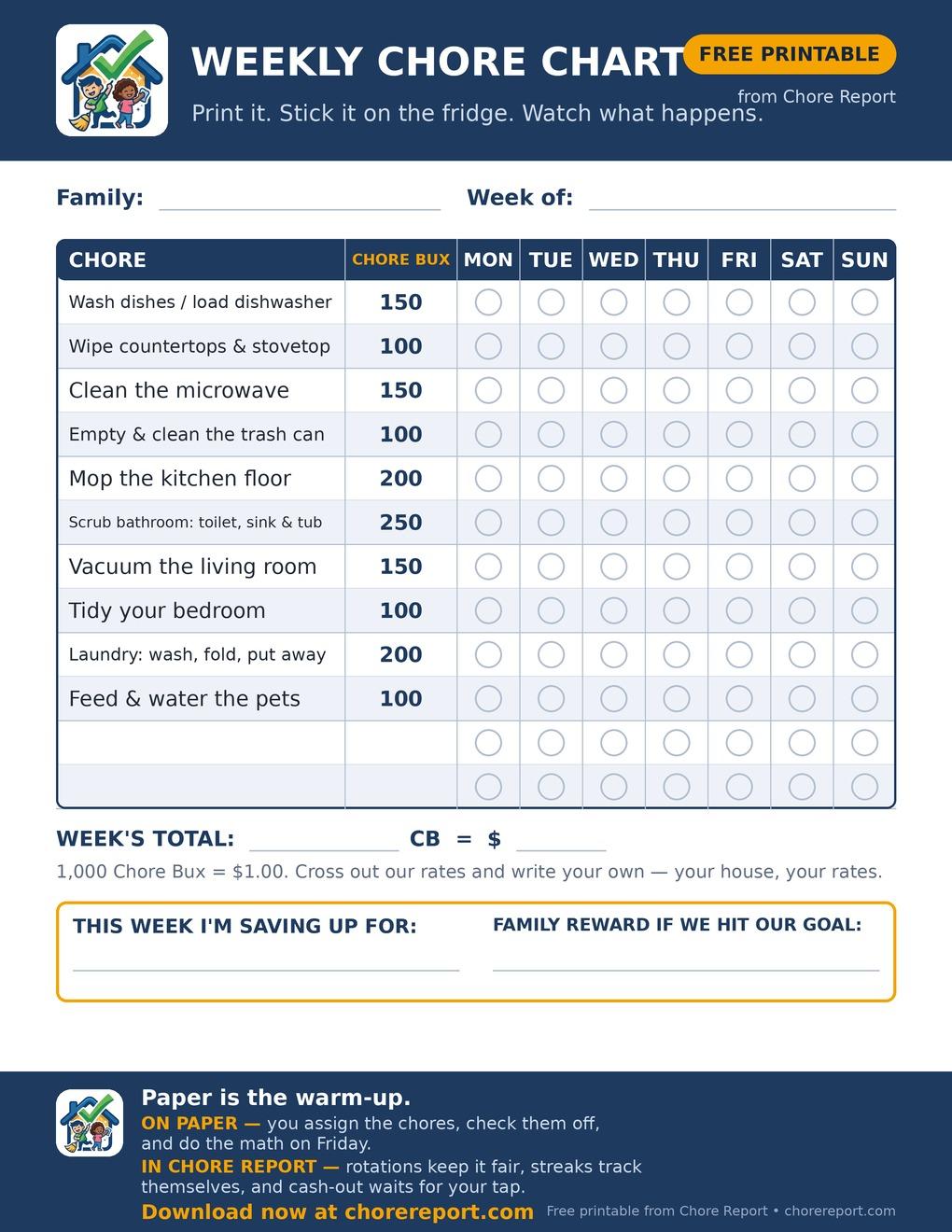
Weekly Chore Chart
Ten common chores with Chore Bux prices, Monday to Sunday checkboxes, a weekly total, and a “saving up for” box. Cross out our rates and write your own.
Free PDF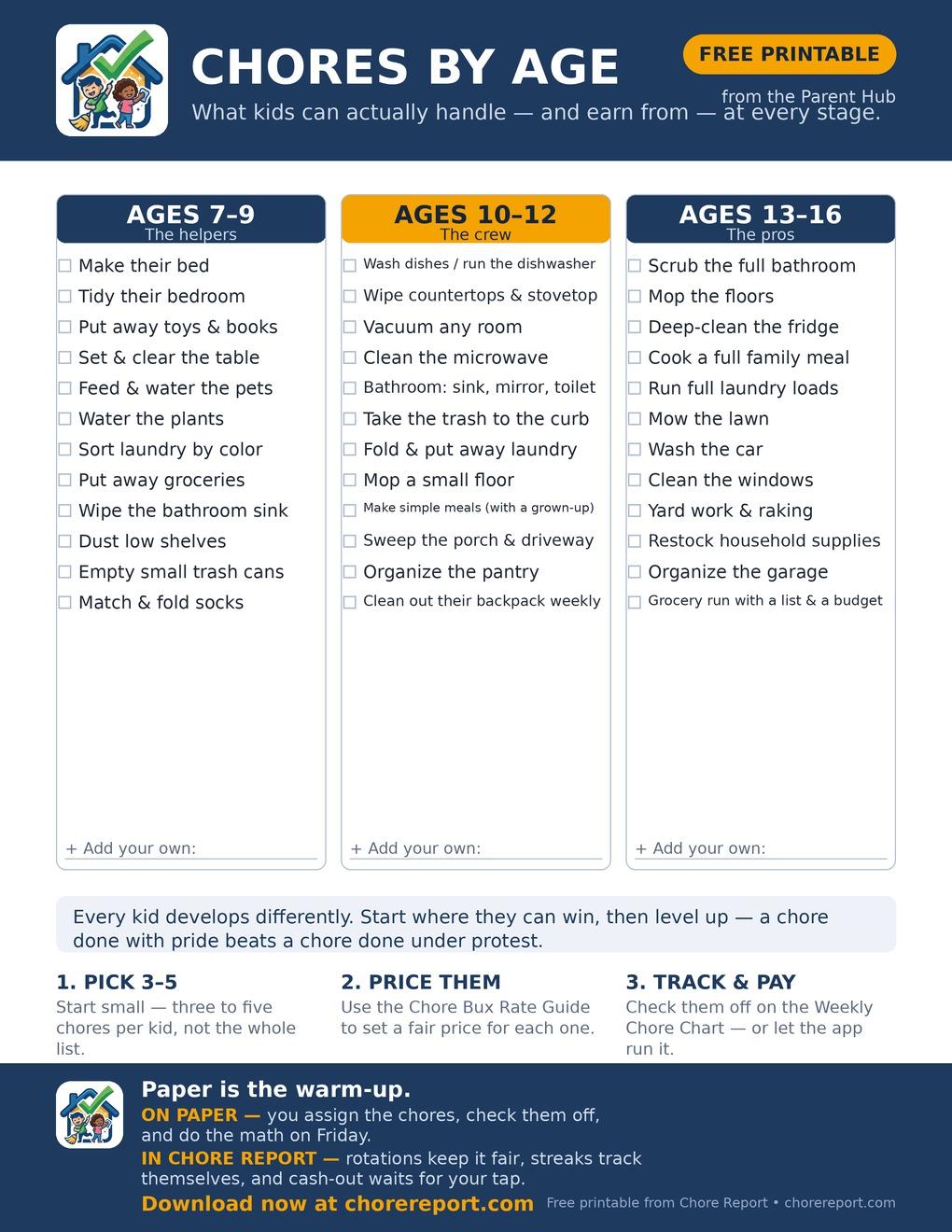
Chores by Age
What 7–9, 10–12 and 13–16-year-olds can actually handle, so the job fits the kid in front of you.
Free PDF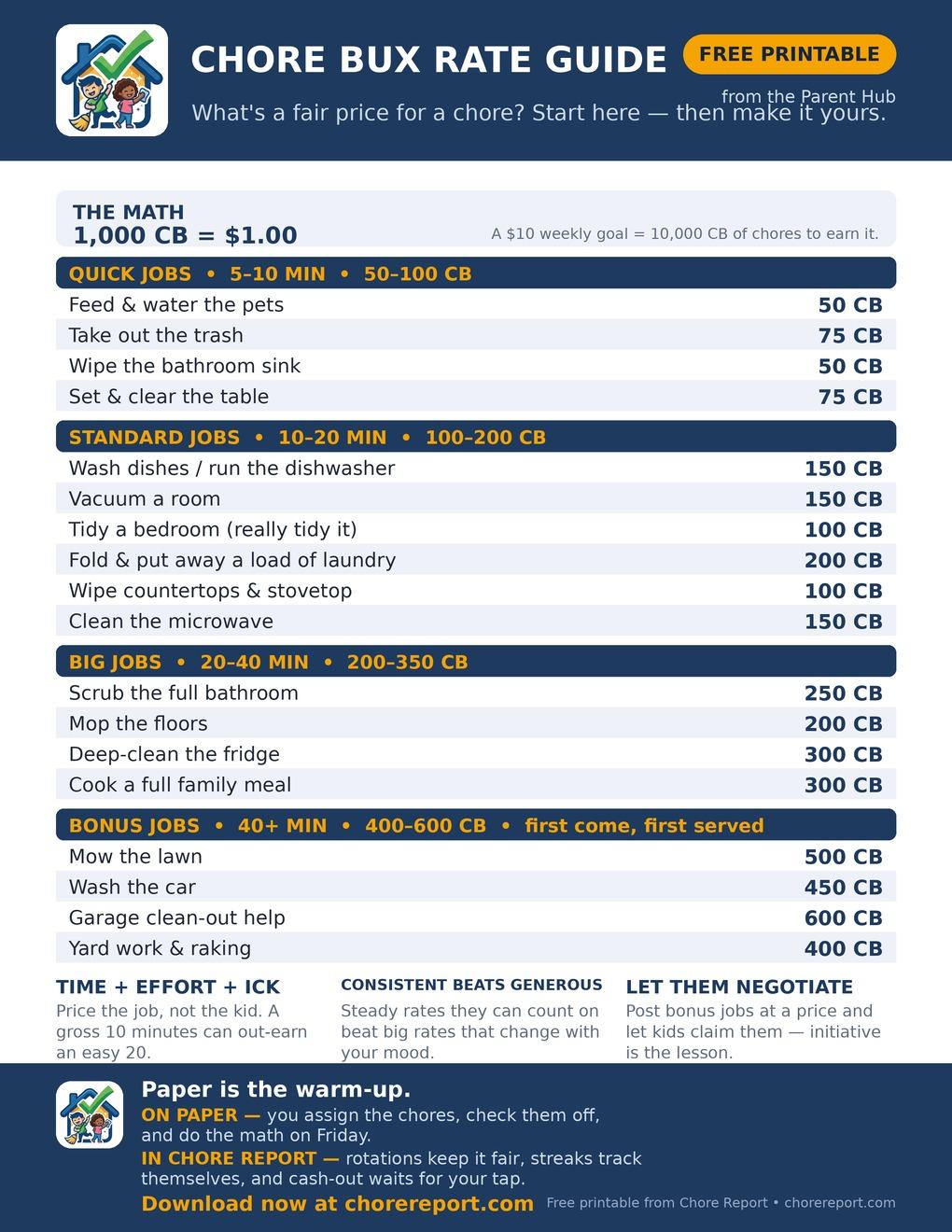
Chore Bux Rate Guide
Fair prices for the 18 most common jobs in four tiers, plus the 1,000 Chore Bux = $1 math.
Free PDF