Why Reminders Fail (and What Works Instead)
By Keosha · The Parent Hub, Chore Report · · 6 min read
It's 6:40 on a school night. The trash has been "about to go out" since 5:00. You've asked four times — nicely, then firmly, then in the voice you swore you wouldn't use. Your kid says "I know, I'm going" in the exact tone of someone who is not going.
The short answer: reminders fail because kids learn to wait for the loud version of you — your voice becomes the system, so they never have to build one. To get kids to do chores without reminding them, move the asking out of your mouth and into a visible system: a chore chart that does the asking, a clear definition of "done," a fair price on each job, and a weekly payday that lets the math — not a lecture — handle the rest.
Here's the part nobody tells you: the reminders aren't failing because your kid is lazy. They're failing because a reminder was never a system. And once you see why, you can't unsee it — or keep doing it.
Why reminders (and nagging) stop working
1. Your voice becomes background noise.
Kids habituate — it's how brains work. The first request registers. The fifth is weather. By the ninth, your voice is just the sound the house makes before dinner. Worse, repeated reminding trains a specific skill: waiting for the louder version. Your kid isn't ignoring the first ask; they've learned the first ask isn't the real one.
2. The reminder IS the system.
When you remember, prompt, check, and follow up, whose job is the chore, really? Your kid has outsourced the remembering to you — you're the notification, the calendar alert, and the project manager. They don't need to build the habit because you're running it for them. Every reminder does the executive-function work their brain was supposed to practice.
3. Nothing changes when it's done — or when it isn't.
No finish line, no payoff, no consequence that isn't just more of your voice. A chore that earns nothing, unlocks nothing, and changes nothing is competing against a phone engineered by thousands of people to be irresistible. It loses every time.
4. "Clean your room" is not a task.
It's a vibe. There's no definition of done, so there's always an argument available about whether it happened. Vague asks produce vague effort — and a debate neither of you wanted.
The system that gets kids to do chores without reminding
The fix isn't a better speech. It's moving the asking out of your mouth and into a system your kid can see, price, and finish.
Make it visible. A chore chart on the fridge doesn't get tired, doesn't raise its voice, and doesn't forget. The chart does the asking; you do the approving. (Our free printable Weekly Chore Chart for kids is built for exactly this — or keep reading for the app version.)
Define "done." Every chore gets a finish line a kid can check themselves against: bed made, floor clear, laundry in the basket. If "done" can be argued, it will be.
Put a price on it. This is the step that changes the temperature in the house. When chores carry Chore Bux — real value a kid is working toward — the question flips from "why should I?" to "what's it worth?" In Chore Report, 1,000 Chore Bux = $1, and parents set the rates. Our Chore Bux Rate Guide prices the 18 most common jobs so you're not inventing numbers at the sink.
Keep a rhythm. Same check-in, same payday. Kids rise to predictable systems and test unpredictable parents. Friday totals beat nightly negotiations.
Let the math do the talking. A missed chore isn't a lecture — it's missed earnings. Quiet, factual, and entirely in their control. That's not a punishment; that's the first honest economics lesson most kids ever get, and research out of Harvard's Making Caring Common project links exactly this kind of real household responsibility to responsibility and self-efficacy in kids.
How to start this week (20 minutes)
- Pick 3–5 chores per kid — matched to their age, not their older sibling's. Our printable chore list by age shows what 7–9, 10–12, and 13–16-year-olds can genuinely handle.
- Price each one using the rate guide. Price the job, not the kid.
- Post the chart, set the payday, and say the most important sentence in this whole system once: "The chart's the boss now — take it up with the chart."
Then stop reminding. The first three days will feel wrong. Let them. A quiet house with an unfinished chore is the system teaching — don't interrupt the lesson by rescuing it with your voice.
Paper or app — your call
Everything above works on paper: you assign the chores, check them off, and do the math on Friday. Plenty of families start there.
Chore Report runs the same system automatically — rotations keep sibling assignments fair, streaks track themselves, kids submit their work, and cash-out waits for your tap, off by default until you turn it on. Paper is the warm-up. The app is the season.
Download now at chorereport.com — and let the chart be the bad guy for a while.
Frequently Asked Questions
How do I get my kids to do chores without nagging?
Replace yourself as the reminder. Post a chore chart where your kid can see it, define exactly what "done" means for each job, attach a price or a goal to the work, and check in once at a set time instead of prompting all day. Nagging fails because it trains kids to wait for the nag; a predictable system removes you from the loop — the chart asks, you approve, payday settles it.
What should I do when my child refuses to do chores?
Don't escalate in the moment and don't do the chore for them — both teach the wrong lesson. State the expectation and the consequence once ("The trash goes out before screens tonight"), then go quiet and let the consequence run. Refusals usually spike in the first week of a new system, while your child tests whether it's real. It gets real the first time the consequence lands without a speech — and stays real when it lands the same way every time.
Should I pay my kids for doing chores?
A common approach — and the one Chore Report is built on — is both: a small set of "you live here" basics (your bed, your plate) stays unpaid as family contribution, and everything beyond that earns. Paying for the extra work teaches that effort has value and gives kids a reason to volunteer for more, while the unpaid basics teach that family membership itself comes with responsibilities.
At what age should kids start doing chores?
Kids can help from about age 6–7 with simple, visible jobs — feeding pets, setting the table, sorting laundry. Ages 10–12 can own whole tasks like dishes, vacuuming, and laundry loads, and 13–16-year-olds can handle big jobs: full bathrooms, cooking a meal, mowing. Match the job to the kid in front of you, not just the birthday — our chore list by age breaks down all three bands.
What if my kid ignores the chart too?
Then the chart isn't connected to anything they want yet. Anchor it to a goal they chose — a game, shoes, an outing — and let one full pay cycle run. Most "ignoring" is testing whether the new system is real. It becomes real the first Friday the math runs without you.
How long until it sticks?
Expect a testing phase of about a week, a working rhythm by week three, and — the part parents write to us about — your kid asking you what's on the chart by the second month.
Run this on paper tonight
Everything in this article works on paper. Print these, stick them on the fridge, and the app can come later. See everything in Door 1.
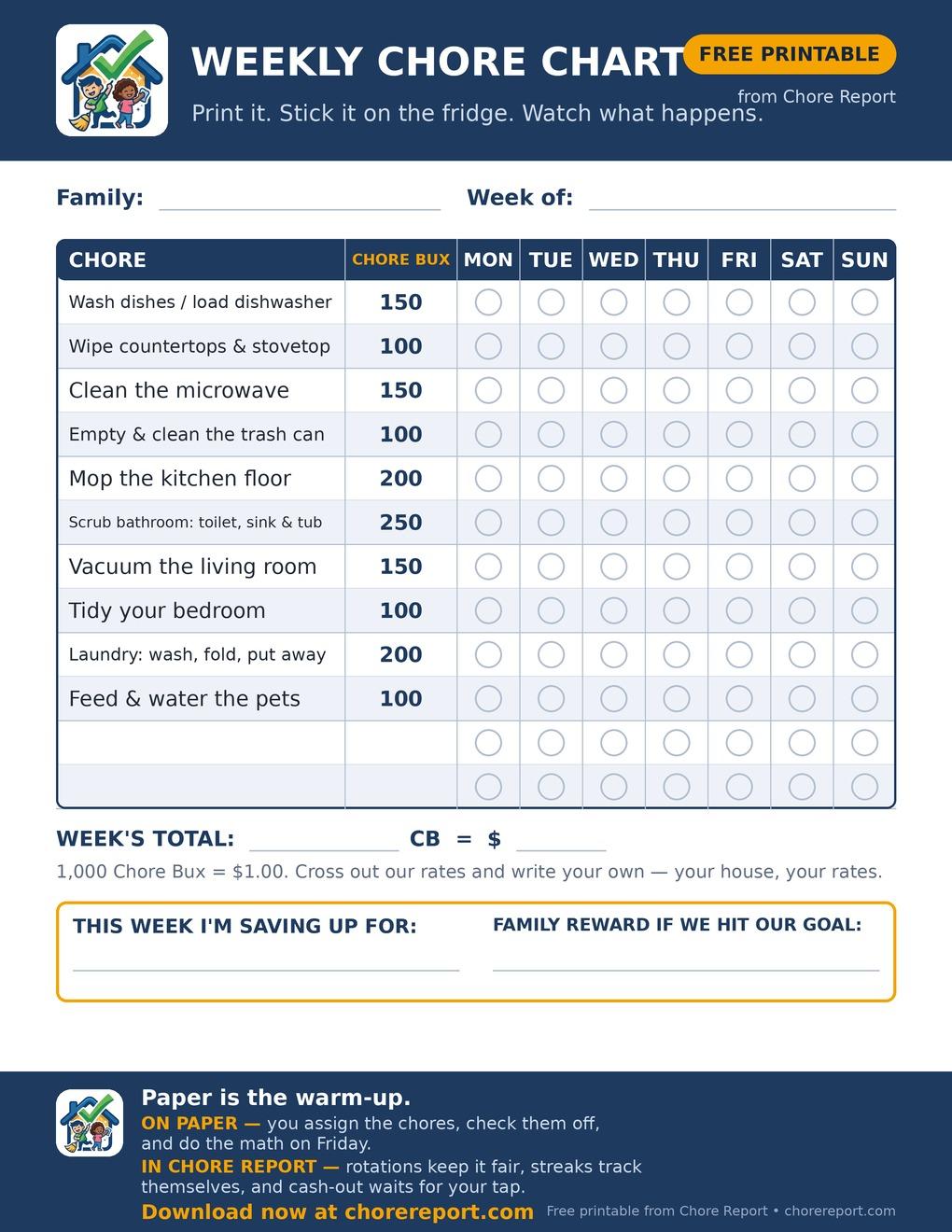
Weekly Chore Chart
Ten common chores with Chore Bux prices, Monday to Sunday checkboxes, a weekly total, and a “saving up for” box. Cross out our rates and write your own.
Free PDF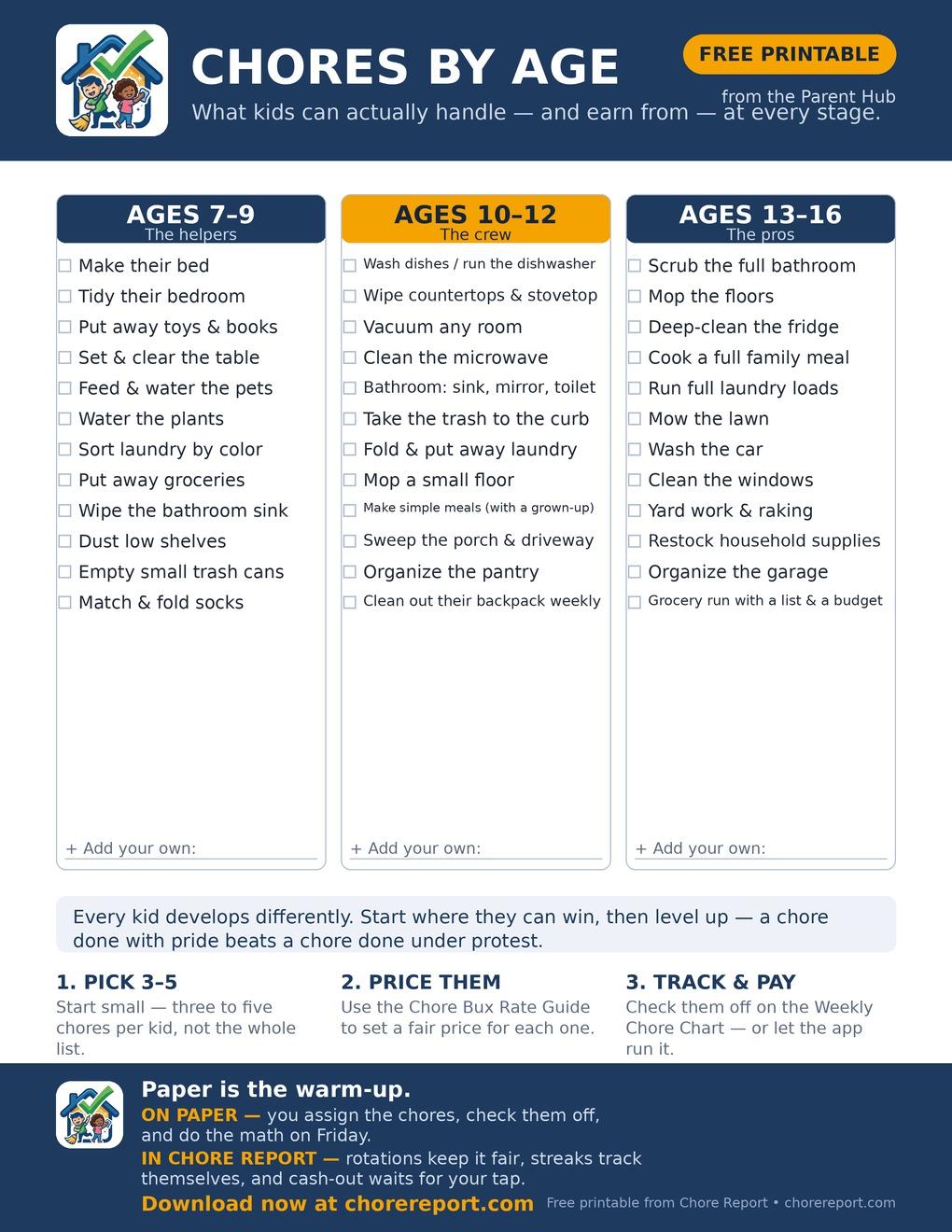
Chores by Age
What 7–9, 10–12 and 13–16-year-olds can actually handle, so the job fits the kid in front of you.
Free PDF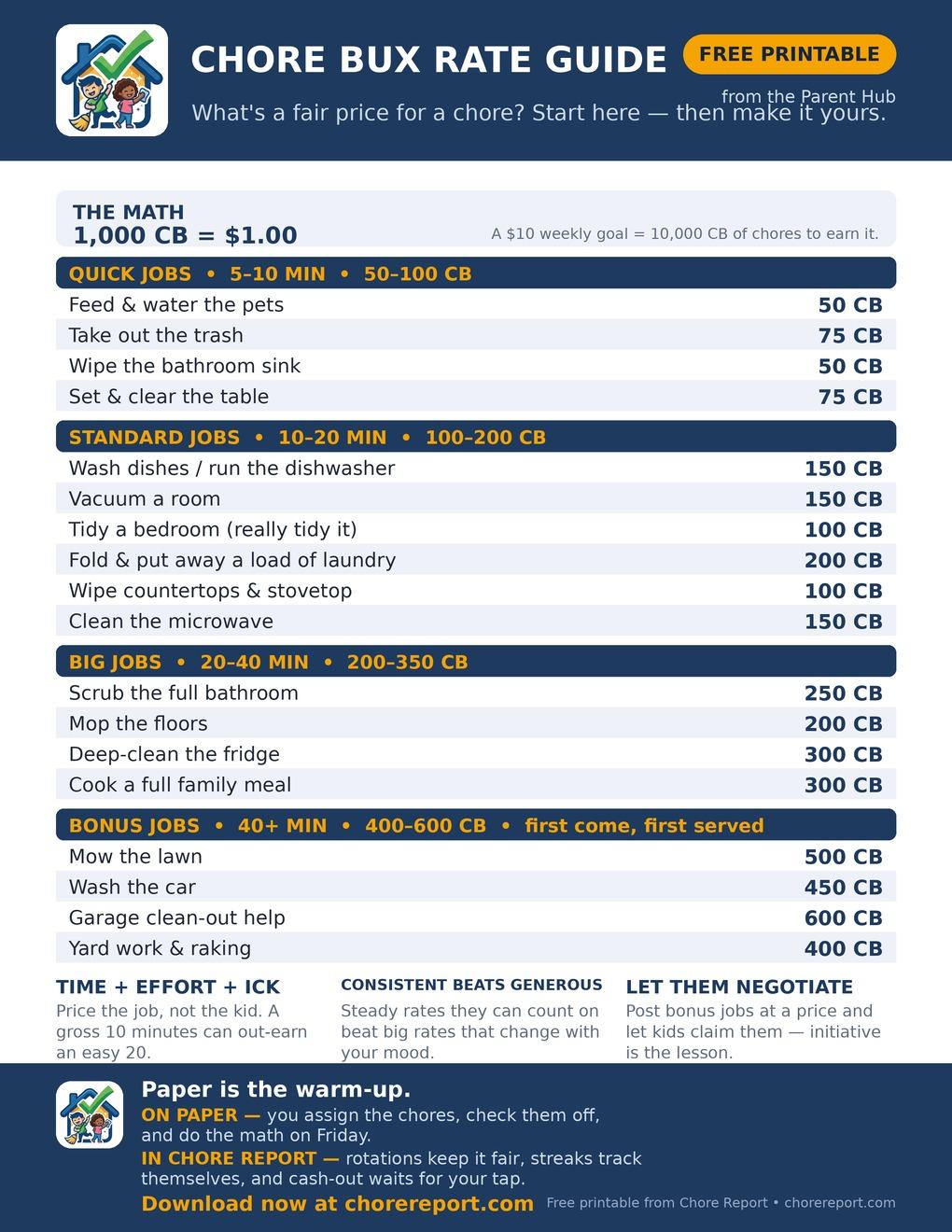
Chore Bux Rate Guide
Fair prices for the 18 most common jobs in four tiers, plus the 1,000 Chore Bux = $1 math.
Free PDF