My Teenager Can't Wake Up in the Morning: What's Really Going On (and How to Fix It)
By Keosha · The Parent Hub, Chore Report · · 9 min read
A pediatric-sleep-backed guide for parents who are exhausted from being the human snooze button.
You've shaken their shoulder. You've yanked the comforter. You've turned on the overhead light, opened the blinds, threatened to take their phone, and at one point you may have stood in the doorway with a cold washcloth like some kind of medieval torturer. And still — still — they're a lump under the blankets at 7:14 AM with the bus pulling up at 7:22.
If you've Googled some version of "my teenager can't wake up in the morning" while standing in their doorway in your robe, I want you to take a breath. You're not failing. They're not lazy. Something real is happening — and once you understand what it is, you can stop the morning war.
The short answer: at puberty, your teenager's internal clock shifts about two hours later — melatonin doesn't start releasing until around 11 PM, so a 6:30 AM wake-up hits them the way 4 AM would hit you. You don't fix that with louder alarms or bigger consequences. You fix the system around it: morning light, a phone that sleeps in the kitchen, bedtime moved in 15-minute steps, and a routine they own instead of one you enforce.
This guide pulls from pediatric sleep research, what actually works in real households, and the systems that keep mornings from melting down. By the end, you'll have a plan.
The real reason your teenager can't wake up
Here's the part most parents don't know: your teenager's brain physically shifted on you.
Around puberty, the body's internal clock — the circadian rhythm — moves later by roughly two hours. Melatonin (the hormone that tells the brain it's time to sleep) doesn't start releasing in teens until around 11 PM, sometimes later. The American Academy of Pediatrics has stated this so plainly it's almost startling: most teenagers are biologically incapable of falling asleep before 11 PM, and waking them at 6 or 7 AM is the equivalent of waking an adult at 3 or 4 AM.
That's not a metaphor. That's the actual sleep deficit you're working against every weekday morning.
Combine that with school start times that haven't caught up to the science, screens in the bedroom, the social pressure of group chats that buzz until midnight, and the academic load of high school, and you get a generation of teenagers walking around in what sleep researchers call "social jet lag" — chronically misaligned with the schedule the world demands of them.
So the kid you can't get out of bed at 6:45? They didn't fall asleep until 12:30. They're not being defiant. They're sleep-deprived in a way that's clinically measurable.
Why "they're just lazy" is the wrong frame
I get the frustration. I really do. But the "lazy" label does two damaging things:
First, it's not true. Sleep deprivation in teens is linked in research to lower academic performance, higher rates of depression, increased risk-taking, and weakened immune function. Your kid isn't choosing to feel terrible — their body is in a fight with their schedule.
Second, the label changes how you parent the problem. If you believe they're lazy, you escalate: yelling, punishments, taking the door off the hinges (don't laugh, parents do this). If you believe they're biologically dysregulated, you build a system. The second approach actually works.
Dr. Mary Carskadon, one of the leading researchers on adolescent sleep at Brown University, has spent decades documenting this shift. Her work — and the work of researchers like Dr. Judith Owens at Harvard — has been the basis for the push to start high schools later. The science is settled. The parenting strategy needs to catch up.
7 things that actually work
Here's what changes mornings, in rough order of impact. None of these are silver bullets. All of them stack.
Quick note: some product links in this article are affiliate links. If you buy through them, Chore Report may earn a small commission at no extra cost to you — it's one of the ways the Parent Hub stays free.
1. Move bedtime earlier in 15-minute increments.
You can't tell a teen who's been falling asleep at 12:30 to suddenly fall asleep at 10. Their body will laugh at you. Instead, shift bedtime earlier by 15 minutes every 3–4 days. Lights out at 12:15, then 12:00, then 11:45. Within a few weeks, you can be at a reasonable bedtime without the body rebellion.
2. Get morning light into their face — fast.
Light is the single most powerful signal to the human circadian system. The moment they're upright, you want bright light hitting their retinas. Sunlight is best. In winter or dark mornings, a light therapy lamp (10,000 lux, sunrise-style) on their desk during breakfast does real work. Sleep specialists at Stanford recommend 20–30 minutes of bright light exposure within the first hour of waking to anchor the rhythm.
3. Replace the standard alarm with a sunrise alarm.
Standard alarms are terrible for teenagers — they jolt them out of deep sleep, which is exactly the wrong time. A sunrise alarm clock (like the Hatch Restore or Philips SmartSleep) gradually brightens over 30 minutes, mimicking dawn. Teens wake up in lighter sleep stages and feel less like they got hit by a truck. This one product changes mornings in many households within a week.
4. Block phones from the bedroom — or at least from the bed.
This is the conversation no parent wants to have, and the one with the biggest payoff. The blue light from screens suppresses melatonin. The dopamine hits from social media keep the brain alert. The notifications wake them up at 2 AM. There's no tech fix that beats "phone charges in the kitchen." The exact words for that conversation are in our free Phone at the Table script — it was written for this moment. If a full bedroom ban is a non-starter in your house (we've all been there), at least: blue-light blocking glasses for screen use after 8 PM; a physical phone charging dock placed across the room, so the alarm function still works but the bed is a phone-free zone; and Do Not Disturb settings enforced from 10 PM to 7 AM.
5. Make the bedroom a sleep cave.
Cool, dark, quiet. That's it. Blackout curtains block streetlights and early sun. A white noise machine masks household sounds and (importantly) sibling traffic. A weighted blanket (10–15 lbs for teens) has a small but real evidence base for improving sleep onset and quality, particularly for anxious teens.
6. Talk to your pediatrician about magnesium and melatonin — carefully.
I'm not a doctor and neither is the internet. But magnesium glycinate is a common, well-tolerated supplement that some pediatricians recommend for teen sleep. Low-dose melatonin (0.3–1 mg, not the 5–10 mg gummies) can help reset the rhythm short-term — but research shows the over-the-counter doses most parents reach for are 10–30x what's actually effective. Less is more. Always check with your kid's doctor first.
7. The "rolling alarm" backup.
For the teen who has mastered the art of slapping the snooze button while unconscious: a Clocky-style alarm clock that rolls off the nightstand and runs around the room sounds gimmicky, but it works because it forces the body upright. And once the body is upright, the brain follows.
The morning routine that sticks
Even with the best biology, mornings still need structure. Here's what works:
The night before: backpack packed and by the door; outfit chosen; water bottle filled, in the fridge; phone charging in the kitchen, not the bedroom.
The morning sequence:
- Sunrise alarm starts brightening at T-30 minutes
- Audible alarm at wake-time
- Feet on floor, lights on, curtains open within 60 seconds
- Cold water on the face (genuinely helps — activates the vagus nerve)
- Light therapy lamp during breakfast
- Same breakfast, same time, every weekday — decision fatigue is real
- Out the door at the same time, every time
The trick isn't motivating them every morning. The trick is removing every single decision from the morning so it runs on autopilot.
When the system beats the battle
Here's the part most morning advice misses: the parent shouldn't be the routine.
If you're the alarm clock, the wake-up nag, the breakfast-server, the bag-checker, the are-you-up-yet voice up the stairs — you're carrying weight that should be distributed across the system. And every interaction is one more chance for friction with a half-asleep teenager who already feels like garbage.
This is where families have started using accountability tools — including ours. Chore Report is the family chore-and-allowance app we built specifically because of mornings like the ones I'm describing. The morning routine — get up, make bed, get dressed, brush teeth, eat breakfast — becomes a sequence of small check-ins inside the app instead of a series of arguments. Your kid sees what's expected. They check things off. You get a quiet notification when they're moving. No nagging. No power struggles. No standing in their doorway in your robe.
It's not magic. It won't fix sleep biology. But it shifts the dynamic from "Mom is the enforcer" to "the kid owns the routine, and the system tracks it."
Crucially, it works with the points-and-rewards economy parents already use — so completing the morning routine consistently can earn screen time, weekend privileges, or whatever you've already negotiated as a family. We didn't invent the bargaining; we just made it less of a daily fight.
If that sounds useful, download Chore Report, set up a household, add your teen, build the morning routine once, and see if the first week of mornings feels different. (Spoiler: usually does.)
When to talk to a doctor
Most teen sleep issues are biology and habit, but not all of them. Talk to your pediatrician if you're seeing:
- Trouble falling asleep that lasts more than 3 weeks despite consistent sleep hygiene
- Loud snoring or pauses in breathing — possible sleep apnea, which is more common in teens than parents realize
- Excessive daytime sleepiness even after a full night in bed (could be narcolepsy, hypersomnia, or thyroid issues)
- Mood changes — depression and anxiety are deeply intertwined with teen sleep, in both directions
- Sleeping 12+ hours regularly, even on weekends
A pediatric sleep evaluation is not extreme. It's information. If something feels off, ask.
You're not doing this wrong
You're parenting a kid whose body is biologically misaligned with the schedule the modern world demands. You're trying to get a 4 AM-equivalent person to stand up at 6:30 AM and do quadratic equations. The fact that you're still showing up — Googling, reading, trying things — already puts you ahead of the curve.
Build the system. Get the light. Move bedtime in 15-minute steps. Use the tools that take the load off you.
And on the mornings it still falls apart? Forgive yourself, forgive them, and try again tomorrow.
That's all any of us are doing.
Frequently Asked Questions
Why can't my teenager wake up in the morning?
Because puberty moves their internal clock roughly two hours later. Melatonin doesn't release until around 11 PM, so most teens physically can't fall asleep earlier — and a 6:30 AM alarm lands in their deepest sleep. They're not lazy; they're running on a schedule their school day doesn't respect. The fix is a system: morning light, an earlier-shifting bedtime, phones out of the bedroom, and a routine that doesn't depend on you.
How much sleep does a teenager actually need?
Pediatric guidance puts it at 8–10 hours a night for teens — and most get closer to 7 on school nights, which is why the deficit shows up as impossible mornings, mood swings, and weekend crash-sleeping. You usually can't add sleep at the morning end (school decides that), so the only lever is the evening end: bedtime, light, and screens.
Should I let my teenager sleep in on weekends?
A little — not a lot. Sleeping until noon feels like recovery, but it re-jet-lags them for Monday (researchers call it social jet lag). Keep weekend wake times within about an hour of the school-day time and let them nap early-afternoon if they're truly depleted. Boring advice, dramatic difference by Wednesday.
What do I do when my teenager won't get up for school no matter what I try?
Stop adding volume and start removing decisions: sunrise alarm, light the moment they're up, phone already in the kitchen from the night before, and the whole morning sequence written down where they can see it — ideally checked off in an app so you're not the scorekeeper. If they've missed the bus, the consequence is theirs to solve (within safety and reason), not yours to absorb. And if nothing works for more than a few weeks, that's a pediatrician conversation, not a discipline one.
As an Amazon Associate, Chore Report earns from qualifying purchases.
Run this on paper tonight
Everything in this article works on paper. Print these, stick them on the fridge, and the app can come later. See everything in Door 3.
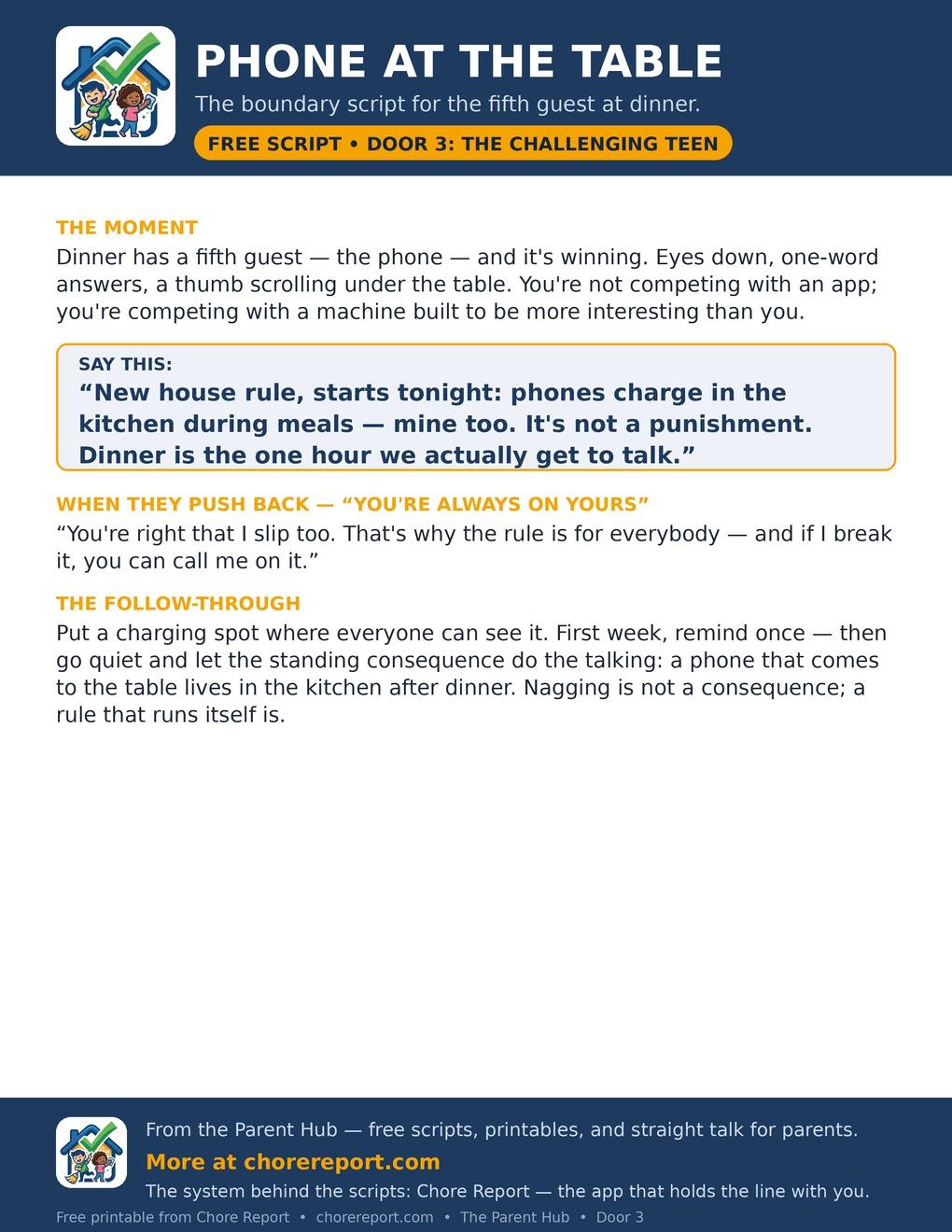
Phone at the Table: Free Script
The boundary script for the fifth guest at dinner: what to say, what to say when they push back, and the follow-through.
Free PDF