How Much Allowance Is Normal? (A No-Guilt Guide by Age)
By Keosha · The Parent Hub, Chore Report · · 6 min read
Every parent asks it, and almost nobody answers it out loud. You hear another parent mention what their kid gets — twenty dollars a week, at nine years old — and suddenly you're doing math in your head and feeling behind. Behind at what, exactly? There's no league table. There's just your kid, your budget, and a number you picked out of the air.
The short answer: there is no "normal" allowance — there's an earnable range that fits your child's age, and it matters far less than the system around it. Most families land near the old rule of thumb — about $1 per year of age per week — but the families whose kids actually learn from allowance don't hand over a flat salary. They price the work: a 7–9-year-old can earn roughly $4–7 a week, a 10–12-year-old $7–12, and a 13–16-year-old $12–25 with bonus jobs. A smaller amount that shows up every single week teaches more than a bigger one that shows up when you remember.
The two questions that actually set the number
What does the money have to cover? A $10 allowance that only buys treats is generous. A $10 allowance that's also supposed to cover school snacks, birthday gifts for friends, and game downloads is a budget crisis with training wheels. As kids get older, the number should grow mostly because responsibility grows: a teen covering their own outings and small clothing buys needs — and learns from — a bigger pot than one whose money is pure fun.
Is it a salary or is it earnings? This is the decision underneath every allowance debate. A flat salary teaches budgeting. Earnings teach budgeting plus the connection between work and money. Our position at Chore Report is both, on purpose: a small set of "you live here" basics (your bed, your plate) is never paid — that's family membership. Everything beyond that is priced work. Your kid gets the dignity of real earnings without learning that breathing in your house is billable.
The guide by age
| Age band | Earnable per week | In Chore Bux |
|---|---|---|
| 7–9 | $4–7 | 4,000–7,000 CB |
| 10–12 | $7–12 | 7,000–12,000 CB |
| 13–16 | $12–25 | 12,000–25,000 CB |
Ages 7–9 — earnable: about $4–7 a week (4,000–7,000 Chore Bux).
The job list is quick and visible: feed the pets, set and clear the table, tidy their room, sort laundry. At the rates in our Chore Bux Rate Guide, five or six jobs a week lands right in this range. What the money teaches at this age: saving toward a specific thing, and the strange power of the sentence "I'm saving up for it." Keep goals close — two to four weeks away, not two months.
Ages 10–12 — earnable: about $7–12 a week (7,000–12,000 Chore Bux).
Now they can own whole tasks — dishes, vacuuming, full laundry loads — and the money starts covering real choices: the pricier snack, the game add-on, a gift for a friend's birthday. This is the age where the goal gets bigger and the waiting gets real, which is exactly the lesson. Introduce the split: some to spend, some to save, some to share — their call on the percentages, your call that all three exist.
Ages 13–16 — earnable: about $12–25 a week (12,000–25,000 Chore Bux).
Teens can do grown-up work — full bathrooms, cooking a family meal, mowing, washing the car — and the rate guide prices those as the big and bonus jobs they are. First-come-first-served bonus jobs are where a motivated teen blows past the top of the range, and that's fine: it's the first honest taste of "the extra work is where the money is." Start shifting real expenses into their budget — outings, hobby gear, small clothing wants — because a teen who has run out of money on the 20th has learned something no lecture teaches.
Not sure which jobs fit which age? Our printable chore list by age lays out all three bands.
Why we price jobs instead of paying a flat salary
The dollar-per-year rule is a fine anchor — it scales automatically and nobody renegotiates every birthday. But a flat number has a quiet flaw: it arrives whether or not anything got done, so the only lesson it reliably teaches is waiting. Pricing the work fixes that. The amount self-adjusts (light week, light pay), the fairness argument disappears (the rate guide is the referee, not you), and a kid who wants more has a lever they control: do more, or claim a bonus job. That's not just allowance. That's a first economy — and research from Harvard's Making Caring Common project links this kind of real household responsibility to the self-efficacy kids carry into everything else.
The three mistakes that make any amount fail
Starting too high. If a 7-year-old starts at $15 a week, there's nowhere to grow and nothing to reach for. Start at the low end of the range — raises are celebrations, cuts are wars.
Changing the number with your mood. Generous after a good week, forgetful after a busy one, and the system is just weather. Consistency is the curriculum: same jobs, same rates, same payday. (This is why the Weekly Chore Chart lives on the fridge — the chart remembers so you don't have to. And if you're still the one doing the reminding, read Why Reminders Fail first.)
No goal. Money with no target evaporates into the nearest snack. Every kid on the system should always be saving toward something they've named — it's on the chore chart for a reason. The goal is what turns "I want it" into "I'm 600 Bux away."
What if we can't afford much?
Then you're in the same boat as most families, and it doesn't disqualify you from any of this. A $4-a-week system run consistently teaches every lesson a $25 system teaches — the amounts scale, the principles don't. Start at the bottom of your kid's range, keep the payday sacred, and let bonus jobs (paid in money or privileges) be the flex. The worst allowance is the big one that quietly stops in week three.
Start here
Pick your child's band, open the rate guide, and price their 3–5 chores. Add it up: if the weekly total lands in the earnable range, you're done — that's their number, and it came from the work, not from another parent's playground confession.
Build the whole system free at chorereport.com — chart, rates, and the app that runs the payday for you.
Frequently Asked Questions
How much allowance should a 10-year-old get?
Most families land between $7 and $12 a week. Rather than picking the number directly, price the work: a 10-year-old doing dishes, vacuuming, and laundry at fair rates earns right in that range — and the number defends itself, because it came from the jobs. If the budget is tight, $5–7 earned consistently beats $12 that shows up irregularly.
Should allowance be tied to chores?
Both, in layers. Basic contributions to the household — a made bed, a cleared plate — should stay unpaid: that's what family members do. Work beyond the basics is where earnings belong. Tying everything to pay teaches kids to invoice their own family; tying nothing to pay wastes the best money teacher you have. The line between the two is yours to draw — just draw it once, out loud.
When should kids start getting an allowance?
When they can count, save toward something, and feel the difference between "gone" and "still there" — for most kids, around age 6–7. Chore Report's system is built for ages 7–16: younger kids need fewer jobs and shorter waits between earning and goal; teens need bigger jobs, real expenses in their budget, and bonus work they can claim.
Cash, card, or app?
Whatever keeps the balance visible and the payday unmissable. Cash works until it gets lost in a bedroom; a note on the fridge works until it smudges. Chore Report tracks Chore Bux automatically — 1,000 CB = $1 — and cash-out happens only when you approve it, in real money, on your schedule. The tool matters less than the ritual: review the week together, run the total, pay.
What do most parents actually give?
Surveys and family-finance guides cluster around the $1-per-year-of-age rule — roughly $7 a week for a 7-year-old, $10 for a 10-year-old, $15–25 for older teens who cover some of their own expenses. Treat those as reference points, not grades. Your family's number is right when it fits your budget, covers what you've decided it covers, and arrives every single week.
Run this on paper tonight
Everything in this article works on paper. Print these, stick them on the fridge, and the app can come later. See everything in Door 4.
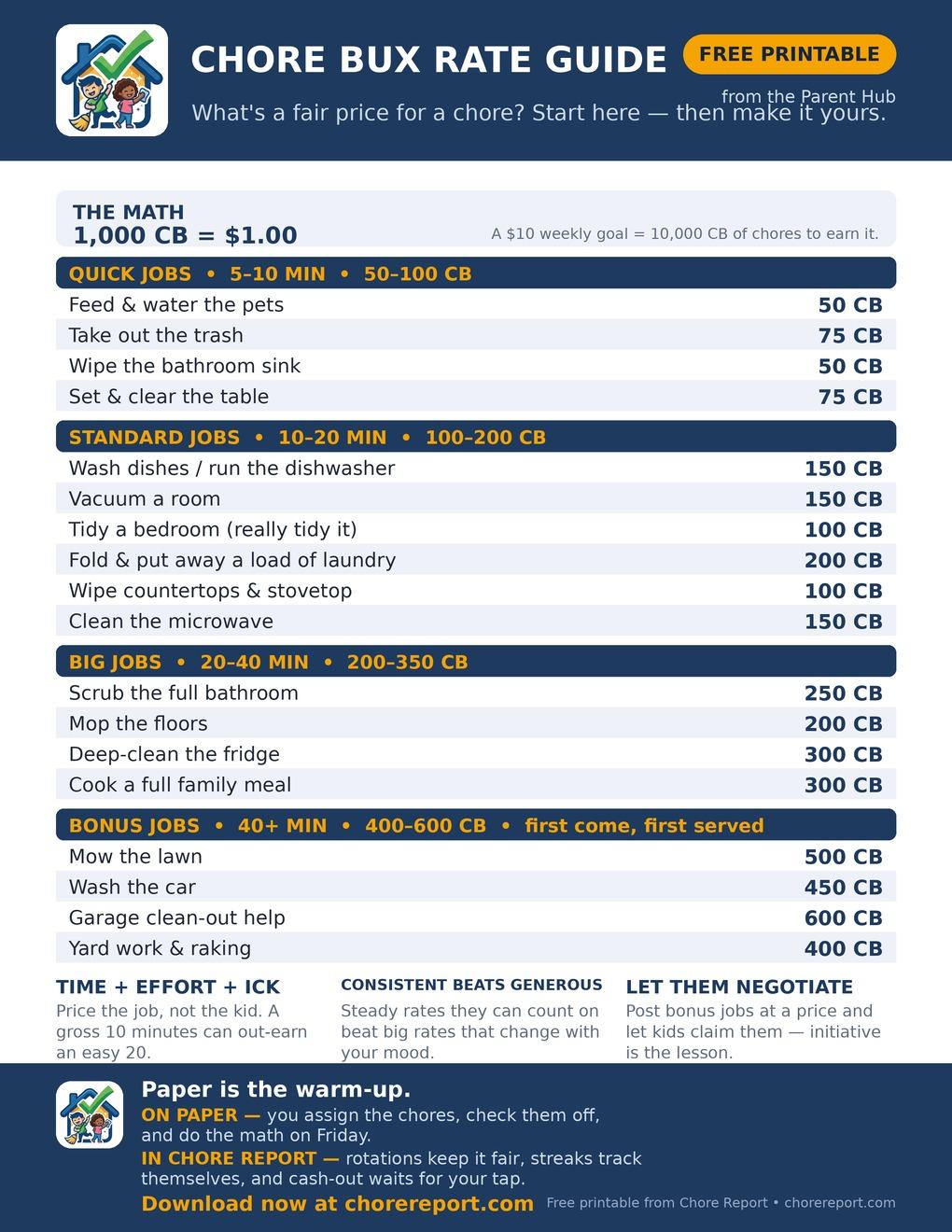
Chore Bux Rate Guide
Fair prices for the 18 most common jobs in four tiers, plus the 1,000 Chore Bux = $1 math.
Free PDF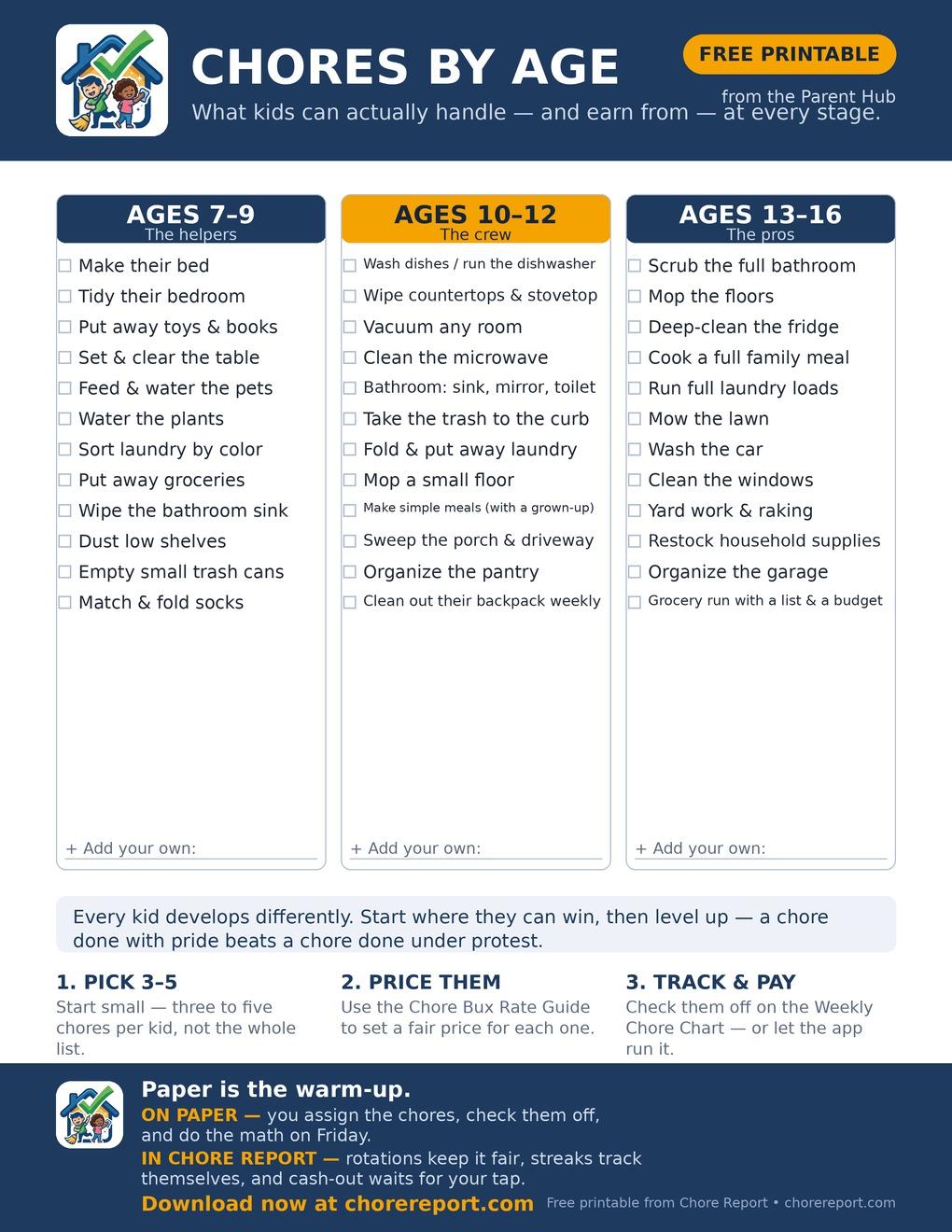
Chores by Age
What 7–9, 10–12 and 13–16-year-olds can actually handle, so the job fits the kid in front of you.
Free PDF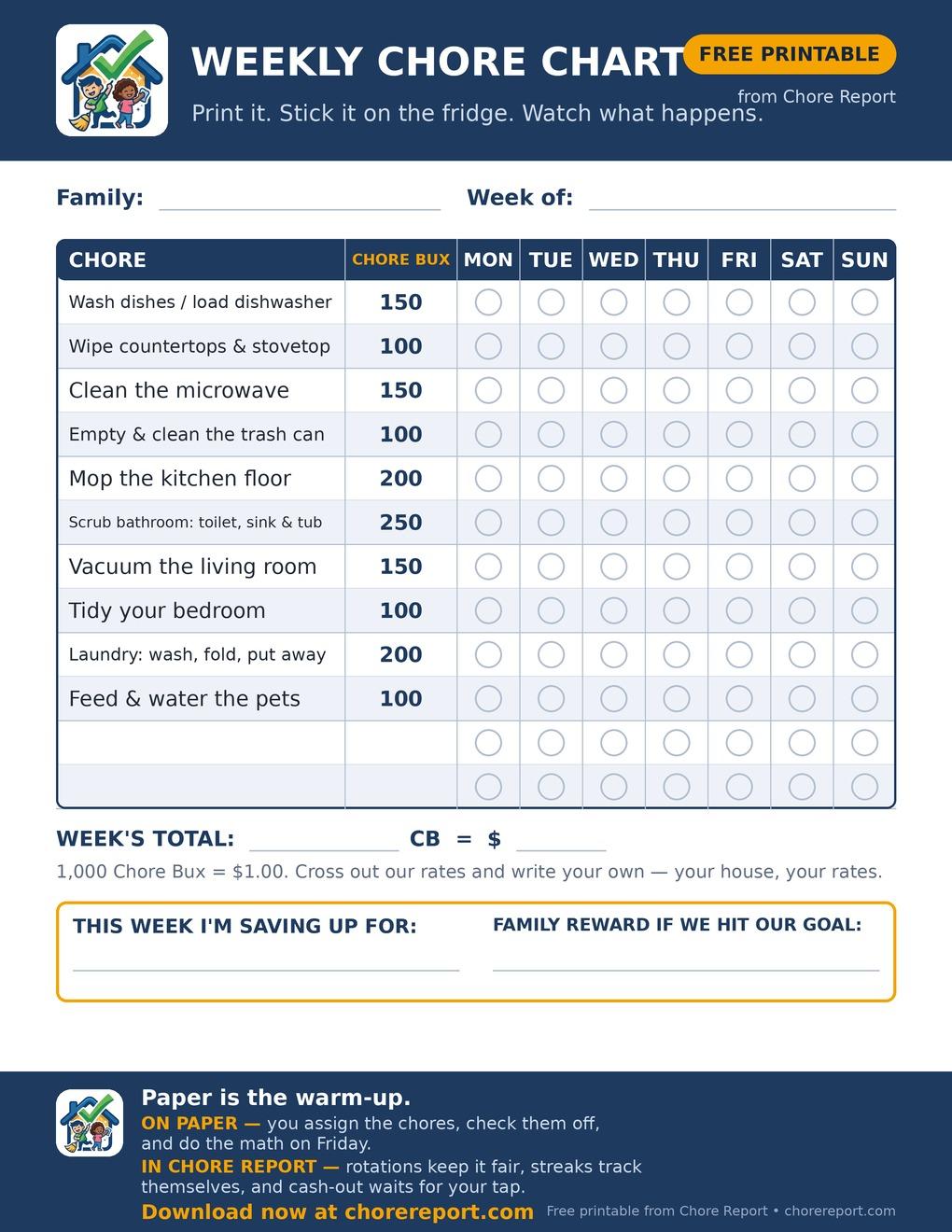
Weekly Chore Chart
Ten common chores with Chore Bux prices, Monday to Sunday checkboxes, a weekly total, and a “saving up for” box. Cross out our rates and write your own.
Free PDF