Saying No Without the Guilt Spiral
By Keosha · The Parent Hub, Chore Report · · 6 min read
"No." You said it at 6:00, calm and clear. By 6:20 it was "okay, fine — but this is the LAST time," and you walked away mad at your kid for asking and madder at yourself for folding. Then comes the spiral: Am I too strict? Am I ruining him? Everyone else's parents seem to just... let them.
The short answer: guilt isn't information — it's just the discomfort of the moment, and caving is how you make it stop today while guaranteeing a bigger fight tomorrow. Saying no to your child without feeling guilty comes down to one shift: decide before the moment, say it once in a complete sentence, and let the discomfort pass instead of negotiating with it. A good no is short, kind, and final.
Why the guilt spiral happens
Guilt feels like evidence. It isn't.
The pang you feel when your kid's face falls isn't proof you're a bad parent — it's proof you love your kid and hate watching them be disappointed. Those are the same feeling wearing different clothes. Parents who never feel the pang are the ones who should worry you. The spiral starts when you treat a feeling like a verdict.
Caving buys quiet now and sells your authority later.
Every reversed no teaches one lesson with total clarity: no is the opening round of a negotiation. Your child isn't being manipulative — they're being a scientist. They ran the experiment (ask again, louder, with tears), and the data says it works. The tenth ask isn't defiance; it's a well-trained habit you both built.
You're not arguing with your kid. You're arguing with a highlight reel.
"Everyone else's parents let them" lands because part of you wonders if it's true. It isn't — at least not the way it's presented. You're seeing other families' public yeses, not their private nos. Every parent you admire has a kid who thinks they're the strictest one on the street.
What a good no sounds like
A good no has four parts, and the whole thing takes about ten seconds:
- Acknowledge. "I get why you want to go — everyone's going to be there."
- Answer. "And my answer is no."
- One reason, one sentence. "It's a school night and you'll be out past midnight." One reason is a boundary. Fourteen reasons is a debate invitation — every reason you add is another handle to argue with.
- Close it. "I'm not going to keep re-deciding this one, but I love you and I'm right here."
Then stop. The hardest part of a no is the silence after it, and that silence is where the learning happens — for both of you.
When they push back (and they will)
Pushback isn't failure; it's the system being tested. Two moments cover most of it, and the Parent Hub has both word-for-word:
The door slam. When the no is answered with a slammed door, the line is: "I heard that. The answer is still no, and I love you. When you're ready to talk without slamming, I'm here." Repair the relationship later — without reversing the decision. Those are two separate conversations.
"Everyone else's parents let them." The line: "Maybe they do. In this house we decide by what works for our family — and my answer on this one is no." If the request actually has merit, revisit it later on your timing — "I've been thinking about what you asked" — so your kid learns a good argument works and pressure doesn't.
The one rule that makes all of this easier
Never decide in the moment what you can decide before it. Most guilt-spiral nos happen at the worst possible time: tired, cornered, in public, with an audience. House rules decided on a calm Sunday — screens, sleepovers, spending — turn a hundred future confrontations into one sentence: "You already know the rule on this one." The rule takes the blame, your kid keeps their dignity, and you skip the spiral entirely.
This is the same principle behind every system that works in a house: the chart decides whose turn it is, the rate guide decides what the job pays, and the rule decides the no. Not because parents shouldn't decide — but because deciding once, calmly, beats deciding nightly, under fire.
What holding the line actually teaches
A kid who hears a steady no learns the world has edges — and that edges aren't rejection. Research from Harvard's Making Caring Common project connects clear household expectations and real responsibilities to the responsibility and self-efficacy kids carry into school and work. The goal was never a quieter evening. It's a kid who can hear "no" from a boss, a coach, or life itself without falling apart — because they practiced at home, with someone who loved them on the other side of it.
Start here
You don't need a new personality. You need the words ready before the moment hits. The Parent Hub's free script library starts with the two hardest ones — The Door Slam and "Everyone Else's Parents Let Them" — written out word-for-word, including what to say when they push back.
Get the free scripts at chorereport.com — and get your no back.
Frequently Asked Questions
Why do I feel guilty saying no to my child?
Because you love them and disappointment hurts to watch — the guilt is a feeling, not a finding. It spikes when you're tired, surprised, or in public, which is exactly when most nos happen. Parents who pre-decide house rules at a calm moment report the guilt drops sharply: you're not rejecting your child, you're enforcing a decision you already made with a clear head.
How do I say no to my child and actually mean it?
Say it once, in a complete sentence: acknowledge what they want, give the answer, give one reason in one sentence, and close it ("I'm not going to keep re-deciding this one"). Then stop talking. Every extra explanation is another opening for negotiation. If you genuinely need time, say so — "This one's a think-about-it; you'll have my answer tonight" — and keep the appointment.
What do I do when my child won't take no for an answer?
Repeat the answer once, word for word, without adding new reasons — then disengage from the debate while staying warm and nearby. Arguing teaches that arguing works. If emotions flood (yours or theirs), pause the conversation, not the decision: "The answer stays no, and we'll talk when we're both calm." Follow through the same way every time; consistency is what ends the testing phase.
Is it okay to change my mind after saying no?
Yes — with one condition: change it later, on your own timing, because you got new information or thought it through — never in the moment, under pressure. A no reversed during a meltdown teaches that meltdowns reverse nos. A no revisited calmly the next day ("I've been thinking about it, and here's what could work") teaches that good arguments and patience work. Kids can tell the difference, and they'll use whichever method you reward.
How do I say no to my teenager without starting a war?
Give the real reason — teens can smell a fake one — and give them the conditions under which the answer changes: "Not this party, because there's no adult there. A party with parents home is a different conversation." You're not just refusing; you're showing them the shape of a yes. That respects their growing autonomy while the boundary stays exactly where you put it.
Run this on paper tonight
Everything in this article works on paper. Print these, stick them on the fridge, and the app can come later. See everything in Door 2.
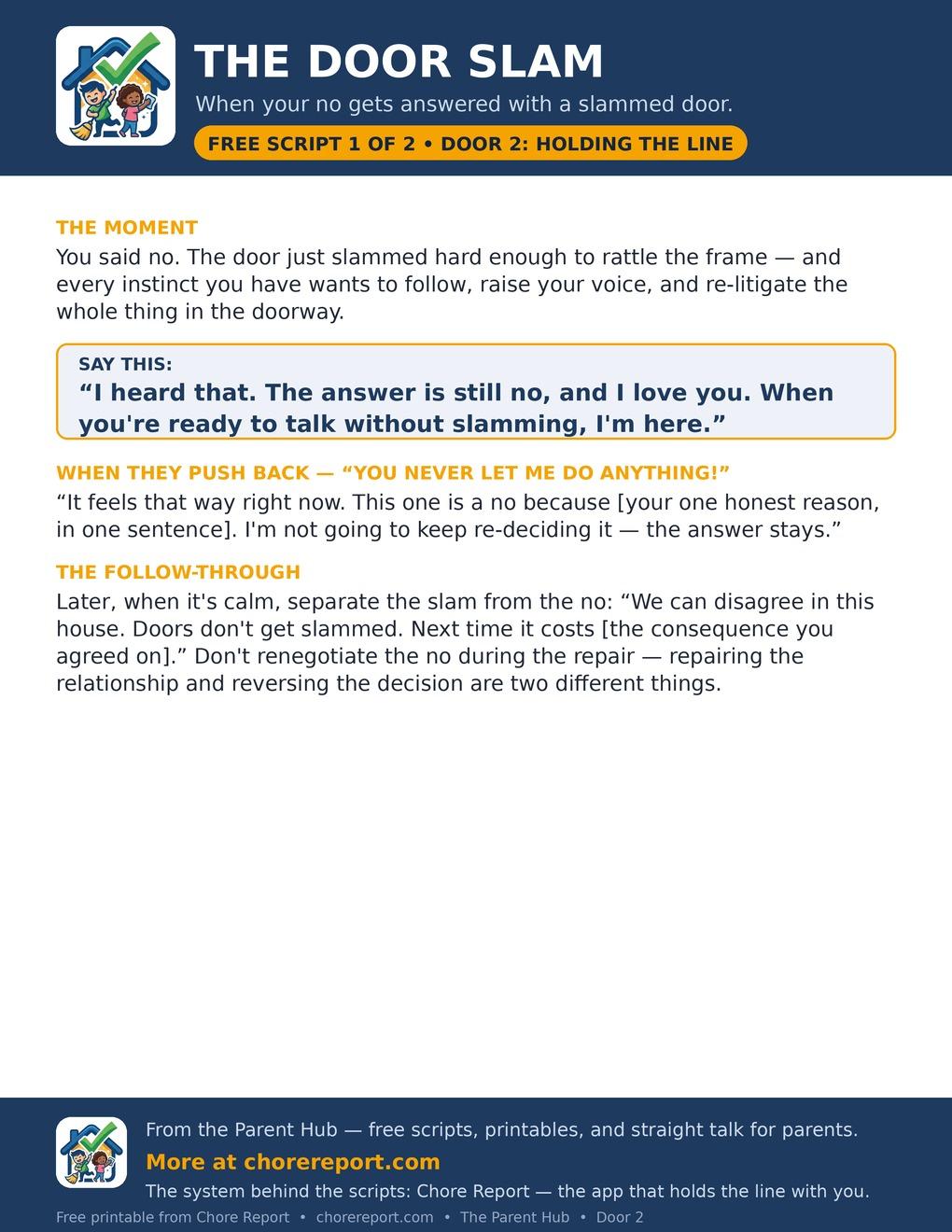
Holding the Line: Free Scripts
The Door Slam and “Everyone Else's Parents Let Them,” written out word for word, including what to say when they push back.
Free PDF (2 pages)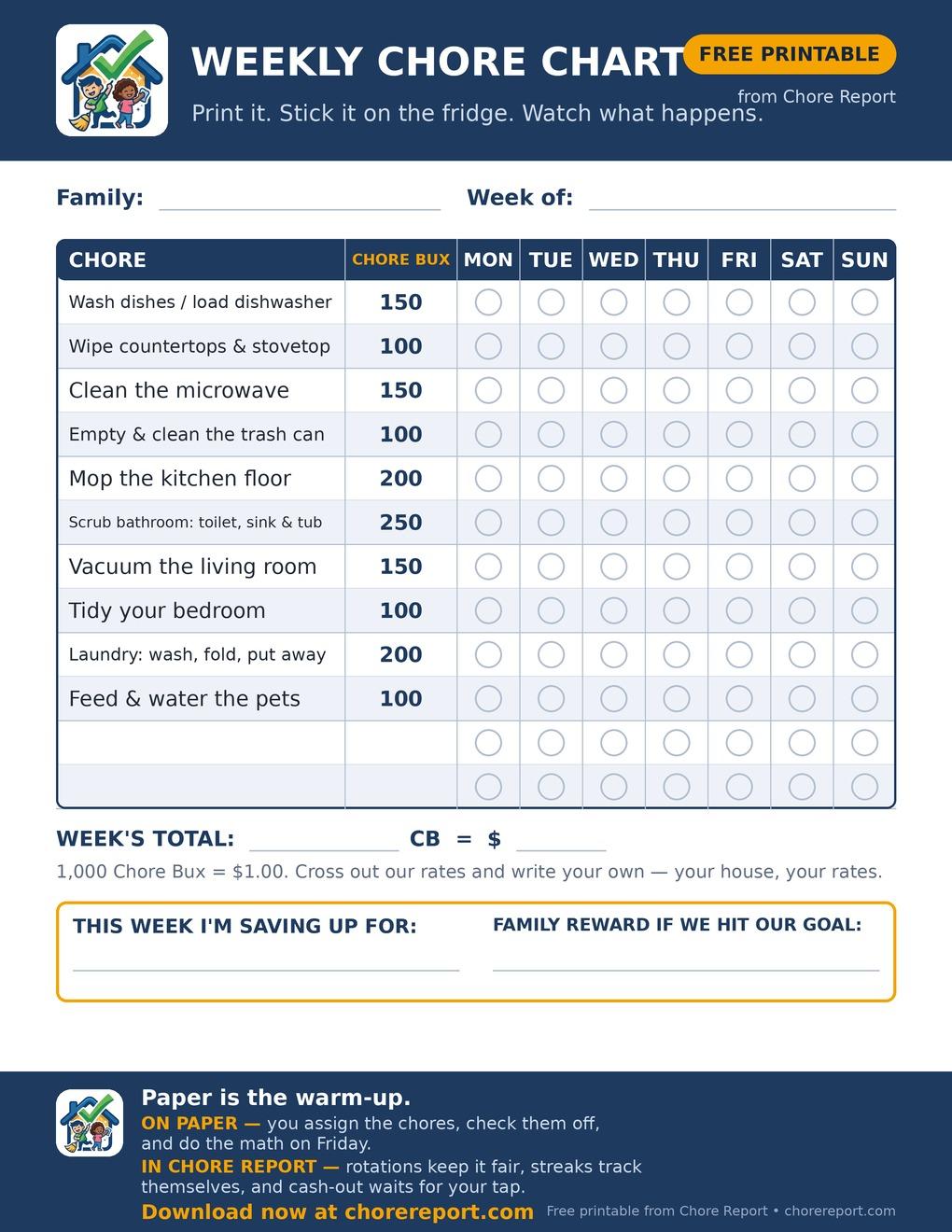
Weekly Chore Chart
Ten common chores with Chore Bux prices, Monday to Sunday checkboxes, a weekly total, and a “saving up for” box. Cross out our rates and write your own.
Free PDF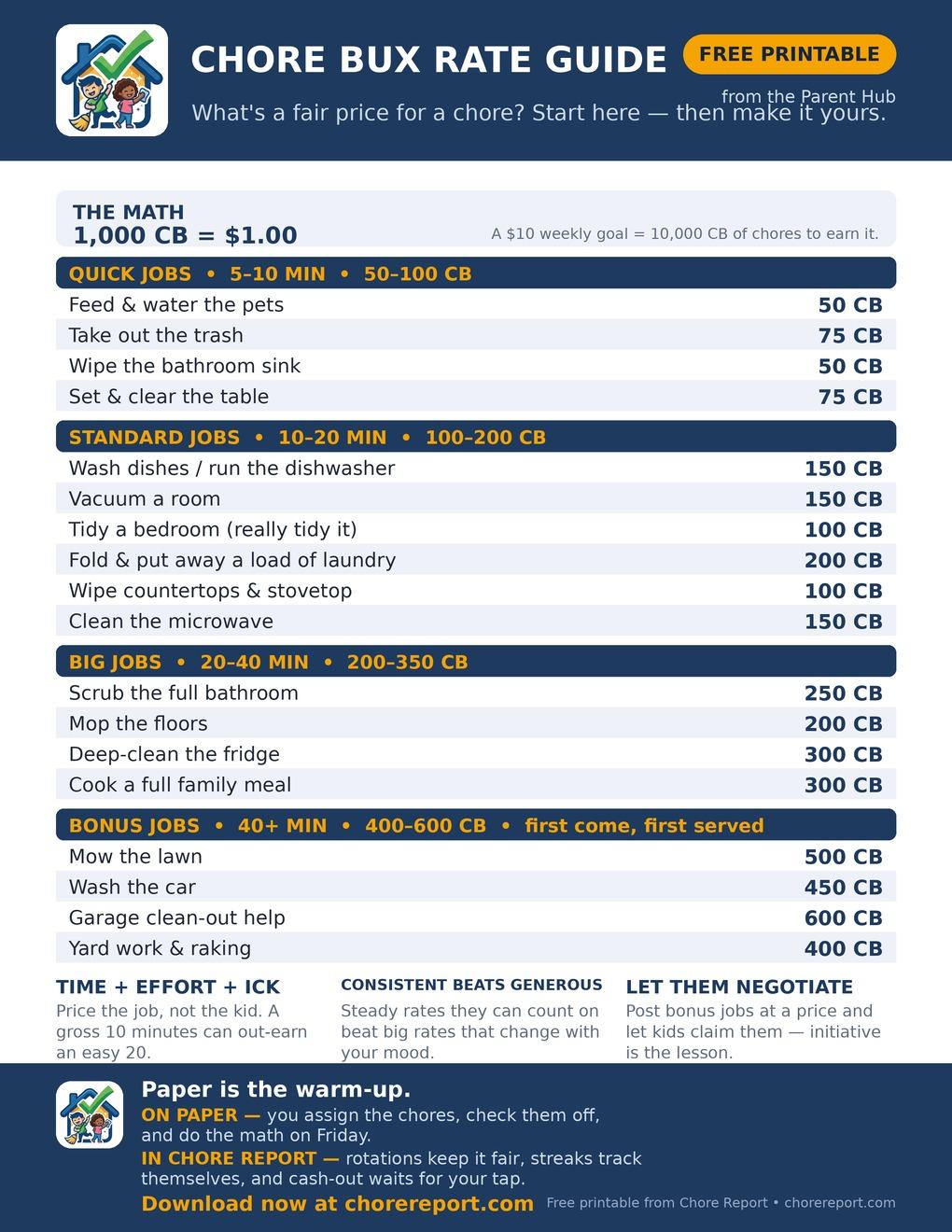
Chore Bux Rate Guide
Fair prices for the 18 most common jobs in four tiers, plus the 1,000 Chore Bux = $1 math.
Free PDF