“He Always Gets the Easy Chore”: Ending the Sibling Fairness Fight
By Keosha · The Parent Hub, Chore Report · · 6 min read

It starts as a murmur and ends as a courtroom. "He always gets the easy chore." "She never has to do the bathroom." "You love him more." Within ninety seconds you're not a parent anymore — you're a judge being asked to rule on a case with no evidence, no precedent, and two lawyers who will appeal any verdict forever.
The short answer: kids don't fight about chores — they fight about fair, and fair can't come from you ruling case by case. Fair has to be a property of the system: jobs rotate so everyone cycles through the good and the gross, jobs are priced by how long and how awful they are so unequal work earns equal respect, and complaints get a scheduled venue — a weekly family meeting — instead of a hallway trial. When the system is the referee, you get to be a parent again.
Why "it's not fair" is never really about the chore
Kids only see their own workload. This isn't selfishness; it's human. Everyone — adults included — overcounts their own contributions and undercounts everyone else's. Your son genuinely believes he does "everything" because his chores are the ones he feels. His sister's invisible work doesn't register. Arguing about whose list is longer is arguing with a perception, and perception doesn't lose arguments.
Assignments from a person feel like favoritism. When you hand out jobs in the moment — "you do the dishes, you take the trash" — every assignment carries your fingerprints. The trash-taker got "let off." The dish-doer got "picked on." It doesn't matter that you alternated yesterday; today it came from you, so today it's personal.
Age gaps make "the same" impossible — and both kids know it. Your teen watches your 8-year-old "help" for four minutes and calls it unfair. Your 8-year-old watches your teen earn bonus money mowing and calls that unfair. They're both right about the facts and both wrong about the conclusion: same was never available. What they need isn't identical treatment — it's a system where the differences are explained by something other than your mood.
The three tools that make fair real
1. Rotation kills the "always" argument.
"He always gets the easy chore" is only possible if assignments are static. When the dishwasher, the bathroom, and the trash rotate on a posted schedule, "always" expires in seven days. Rotation also teaches the quiet lesson underneath this whole door: doing the gross job sometimes is how you learn what it costs the person who usually does it. That's empathy with a mop in its hand — and it's why Harvard's Making Caring Common project connects household contribution to kids' empathy and family connection, not just their work ethic.
2. Prices make unequal jobs equal.
Dishes take fifteen pleasant minutes; the bathroom takes twenty-five unpleasant ones. Treating them as "one chore each" is how resentment is manufactured. Price them instead — time plus effort plus ick — and the unfairness drains out of the math. Our Chore Bux Rate Guide does this with four tiers, so "her job is worth more than mine" stops being an insult and becomes a choice: fine, claim the bathroom next week and earn the 250. (The full pricing system lives behind Door 4, if money fairness is your bigger fight.)
3. A court of appeal that meets weekly.
Complaints need somewhere to go that isn't your last nerve. The family meeting is that venue: fifteen minutes, same time weekly, where fairness claims get heard, swaps get proposed, and decisions get made — and then the topic is closed until the next meeting. Our free Family Meeting Agenda has the whole flow on one page, including the fairness check as item three. The sentence that makes it work is some version of: "That's a meeting topic. Bring it Sunday and we'll vote it." You've just converted a daily argument into a weekly agenda item — and half the time, Sunday's vote goes to whoever complained, which teaches them the system listens.
What to say in the moment
When the courtroom opens anyway — and it will, especially in week one — you need lines, not rulings:
"Fair isn't everyone doing the same job. Fair is everyone doing their share across the week — and the chart keeps the score, not me."
"You're right that the bathroom is the worst one this week. It's also worth the most, and it's yours to claim next week if you want the Bux."
"I hear you. Bring it to the meeting on Sunday and make your case — if your brother agrees it's uneven, we'll swap it."
Notice what none of these do: litigate. You acknowledge, you point at the system, you give the complaint a time and place. Then you stop — the same discipline as holding a no.
Set it up this week
- List every recurring job on one page, with the kids in the room. Half the fairness problem is invisible work — jobs nobody counted can't be divided.
- Sort the list into rotations using our printable chore list by age so the age gaps are handled by the bands, not by debate.
- Price anything that isn't equal with the rate guide — the bathroom and the dishes stop being a feud the day they stop pretending to be the same job.
- Post the chart, set the meeting. Put the Weekly Chore Chart where everyone can see it and hold the first family meeting with the agenda. Fifteen minutes. Timer on.
In Chore Report, this whole structure runs itself: rotations cycle automatically, weights live on each chore, and the scoreboard is visible to every kid — so "he always gets the easy one" meets a chart that simply disagrees.
Frequently Asked Questions
How do I divide chores fairly between siblings of different ages?
Don't divide by sameness — divide by capacity and rotate within it. Each child gets jobs from their own age band (our chore list by age lays out 7–9, 10–12, and 13–16), the shared household jobs rotate among everyone who can do them, and harder jobs pay more so the older kids' heavier load is answered with heavier earnings and privileges. Fair means the share fits the kid, not that the lists match.
Should siblings get the same allowance?
They should get the same opportunity, not the same number. Same rates, same chart, same payday — different totals, because a 15-year-old can earn from big and bonus jobs a 9-year-old can't do yet. Identical pay for different work teaches the older child that effort is pointless; identical rules teach both of them the system is honest.
What do I do when one child really is doing more than the other?
First, check the chart instead of the volume of the complaint — sometimes the louder kid is right, and the fix is a rotation or price adjustment at the family meeting, made openly so everyone sees the system correct itself. If the imbalance is real and repeated (one kid claiming every bonus job, one kid quietly opting out), that's not a fairness problem anymore; it's a follow-through problem, and the missed earnings — not a speech — should deliver the message.
How do I respond when my child says "that's not fair" without starting an argument?
Agree with the feeling, name the system, offer the venue: "It does feel uneven this week. The rotation moves the bathroom to your brother on Monday — and if you want to propose a swap, bring it to Sunday's meeting and we'll vote." You've validated them, shown the fairness mechanism working, and given their complaint a real path to change something. Most "not fair" storms end there, because what kids want most is evidence that fairness exists — not victory in this particular case.
Run this on paper tonight
Everything in this article works on paper. Print these, stick them on the fridge, and the app can come later. See everything in Door 5.
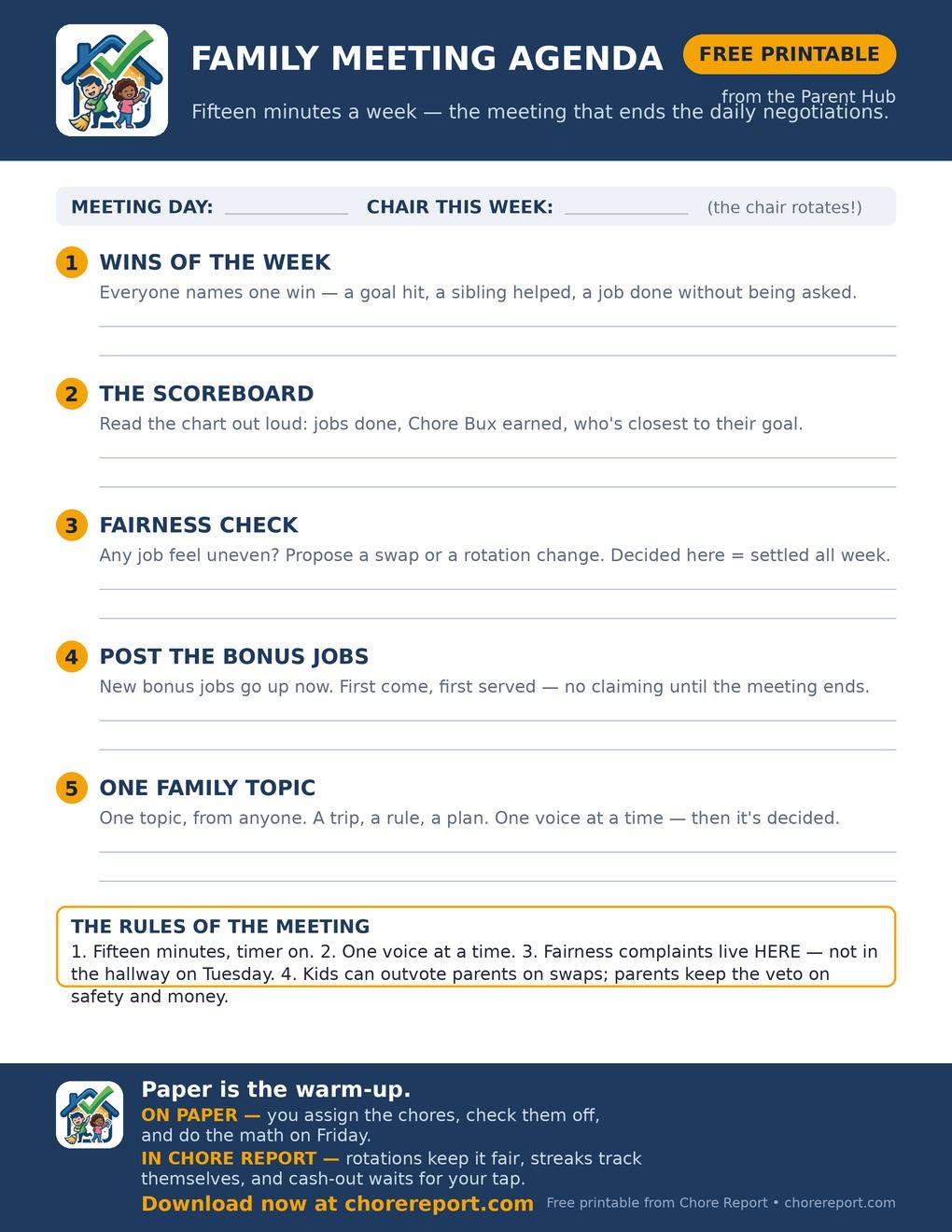
Family Meeting Agenda
Fifteen minutes a week: wins, the scoreboard, the fairness check, bonus jobs and one family topic.
Free PDF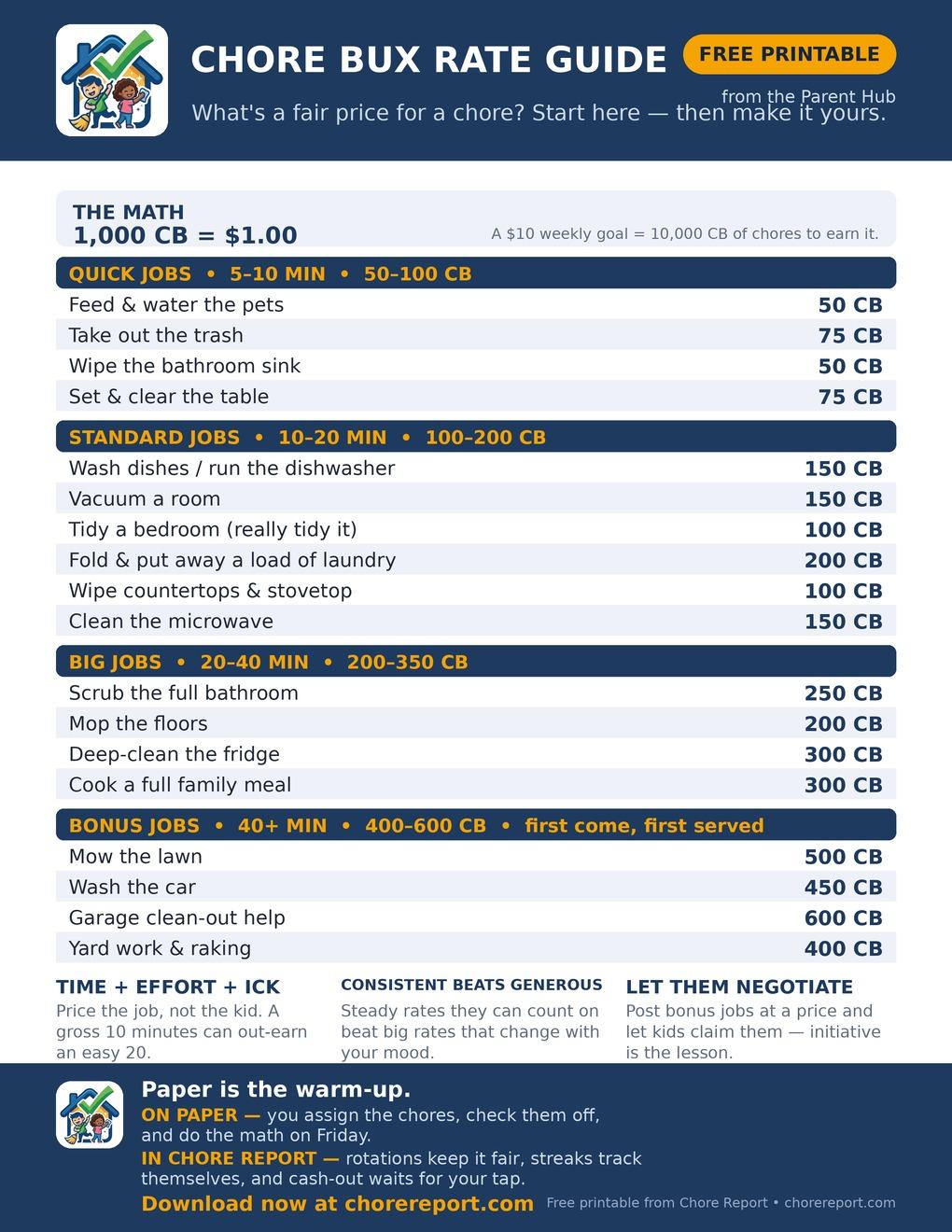
Chore Bux Rate Guide
Fair prices for the 18 most common jobs in four tiers, plus the 1,000 Chore Bux = $1 math.
Free PDF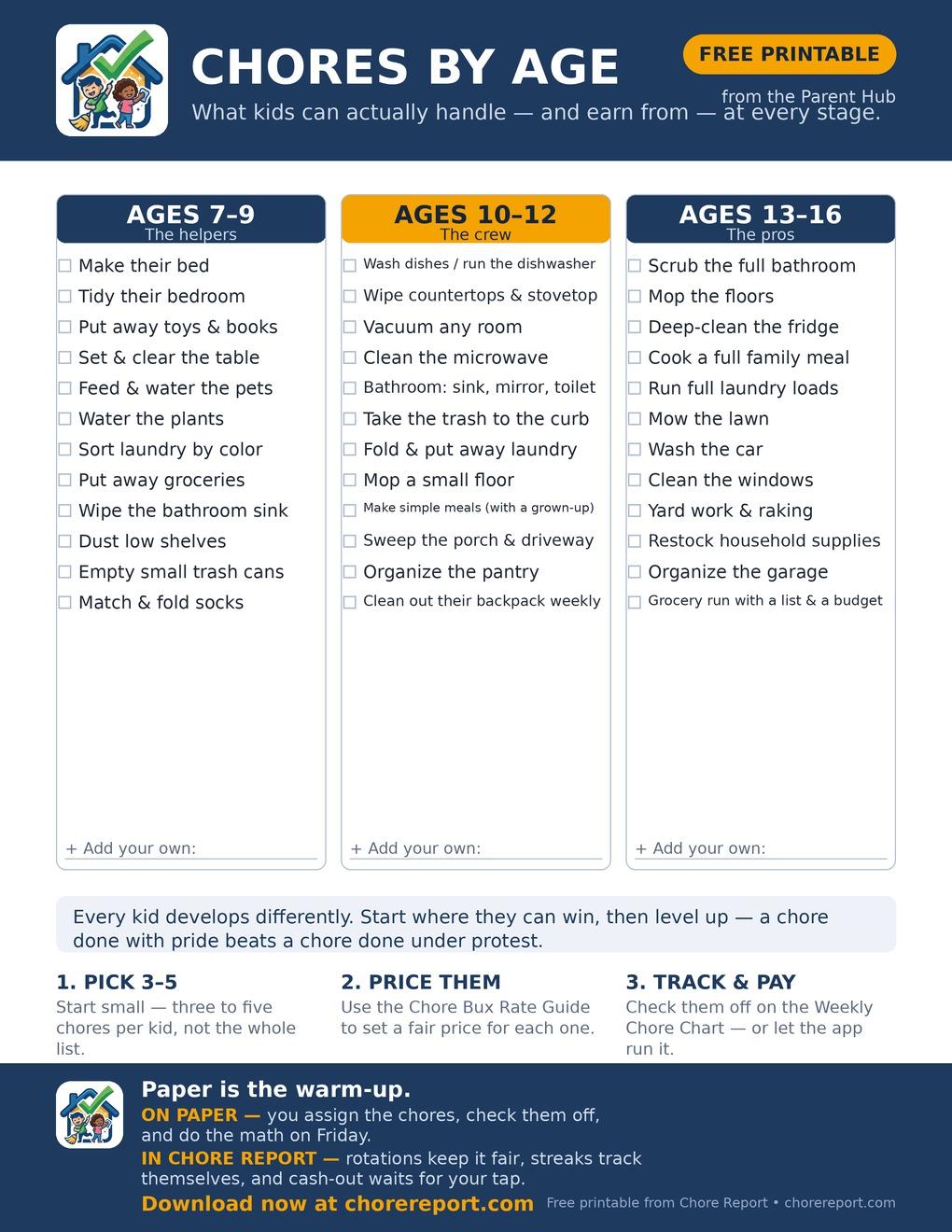
Chores by Age
What 7–9, 10–12 and 13–16-year-olds can actually handle, so the job fits the kid in front of you.
Free PDF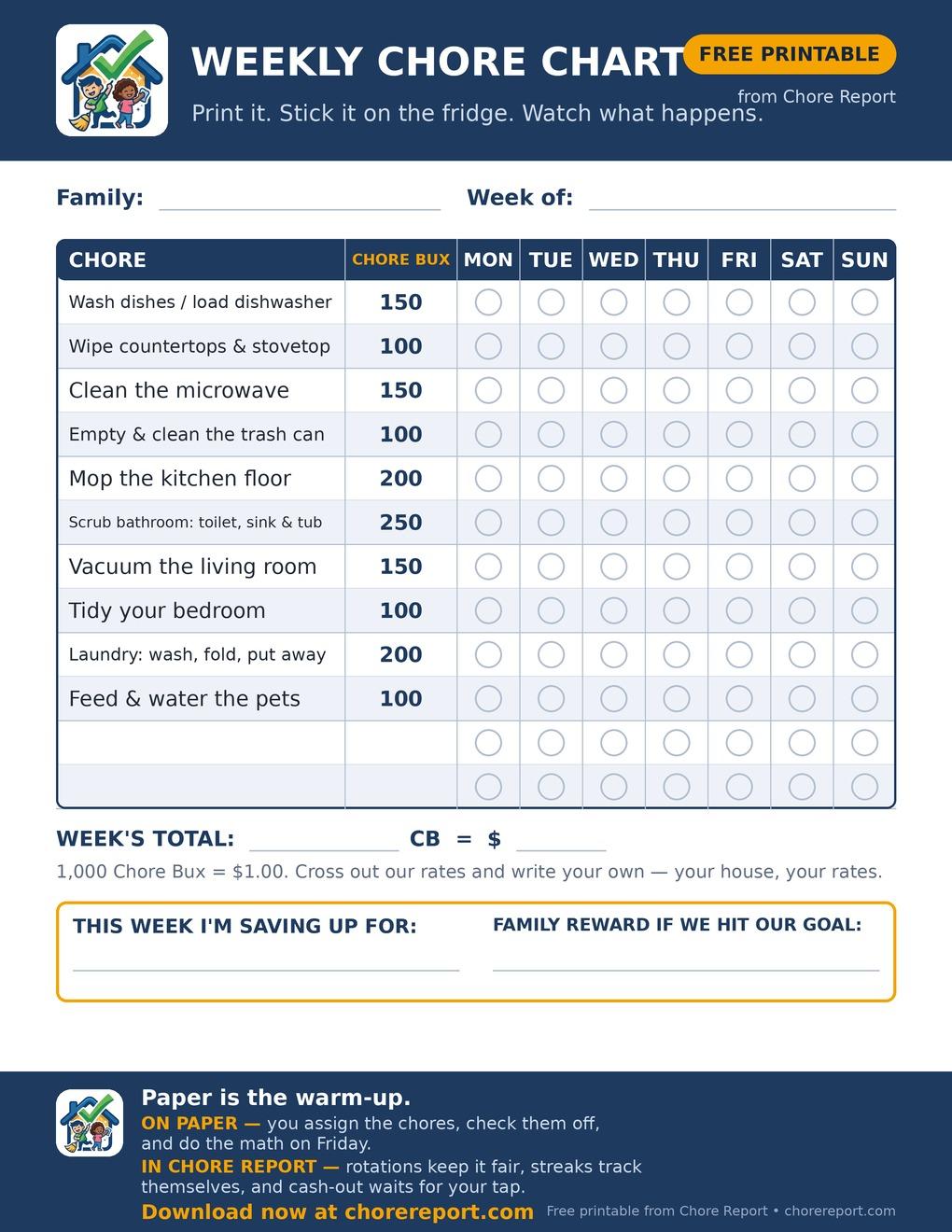
Weekly Chore Chart
Ten common chores with Chore Bux prices, Monday to Sunday checkboxes, a weekly total, and a “saving up for” box. Cross out our rates and write your own.
Free PDF